The Fun and Function of Tracing Letters KDP Interiors: A Complete Guide
In the bustling world of independent publishing and educational resources, a simple yet powerful tool has emerged for creators and educators alike: Tracing Letters Interiors. These specialized book interiors, designed specifically for platforms like Amazon's Kindle Direct Publishing (KDP), offer a structured, engaging way for children to learn the fundamentals of writing. At their core, these KDP interiors contain all the letters—both uppercase and lowercase—each page adorned with funny characters to delight young learners. They represent a perfect blend of education and entertainment, tailor-made for the low and no-content book business, providing a ready-to-use solution for professional and personal projects.
Understanding Tracing Letters KDP Interiors
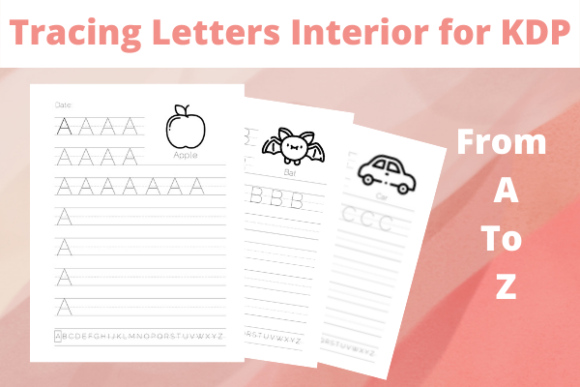
To grasp the significance of these resources, we must start from the ground up. A "KDP Interior" is the complete inside layout of a book—all the pages from the first to the last—formatted to meet Amazon's technical specifications for paperback publishing. When this interior is focused on "Tracing Letters," it becomes a dedicated practice book for early literacy skills. Each page systematically introduces a letter of the alphabet. The child's task is to trace over the dotted or grayed-out form of that letter, building muscle memory and understanding its shape.
The inclusion of both uppercase and lowercase letters is crucial. It mirrors the natural progression of learning, where children often recognize capital letters first but must quickly master the lowercase forms used in most reading and writing. The "funny characters" on each page—perhaps a smiling apple next to 'A' or a giggling ghost next to 'G'—serve a dual purpose. They create a joyful, less intimidating learning environment and provide a visual cue that aids in letter association and retention.
The Purpose and Significance in Early Education
The primary purpose of these tracing interiors is foundational skill development. Handwriting is a complex motor and cognitive task. Tracing reduces the cognitive load, allowing the child to focus on the physical act of forming the letter correctly. This repetitive practice strengthens fine motor control, hand-eye coordination, and the neural pathways associated with writing. In a world increasingly dominated by keyboards and screens, the physical act of writing remains a vital part of cognitive development and literacy.
Furthermore, these books fit seamlessly into modern educational approaches. They are perfect for homeschooling parents seeking structured materials, for teachers looking for supplemental classroom activities, or for caregivers wanting to support learning at home. Their design acknowledges that learning must be engaging to be effective. The funny characters transform a drill into a playful activity, aligning with the philosophy that early education should cultivate a love for learning, not just rote skill acquisition.
The Practical Relevance: Low and No-Content Business
This is where the concept expands beyond the classroom into the realm of entrepreneurship. "Low and no-content" books are publications that require minimal original writing from the creator. Journals, coloring books, planners, and practice books like tracing letters interiors fall into this category. They are a popular niche on KDP because they allow individuals to create and sell useful products without being professional authors or graphic designers.
A tracing letters interior that is 100% formatted and tested for KDP, ready to upload, is a golden asset. It eliminates the technical barriers to entry. The creator does not need to learn complex page layout software, worry about margin settings, or stress over file compatibility. They receive a complete, professional-grade PDF—the standard format for KDP interiors—that is guaranteed to meet Amazon's requirements for a 131-page paperback with dimensions of 8.5 x 11 inches and no bleed (meaning the design does not extend to the edge of the page). This practicality empowers a wide range of people: educators wanting to share their methods, parents creating custom books for their children, or aspiring entrepreneurs building a publishing business.
Clarifying Common Misunderstandings
A common assumption is that "no-content" means no value. This is a significant misunderstanding. The value lies in the expert curation and design of the activity. A well-structured tracing book interior is a pedagogical tool. Another misconception is that such products are only for very young children. While they are ideal for preschoolers and kindergarteners, they are also valuable for older children who need extra handwriting practice or for individuals learning English as a second language. The utility is broader than it initially appears.
Furthermore, the term "ready to upload" sometimes leads people to think no effort is required. In reality, the creator still undertakes the crucial tasks of market research, crafting a compelling book title and description, designing an attractive cover (often using a provided JPG image), and setting up their KDP listing. The interior solves the most complex production hurdle, but successful publishing involves a blend of this ready-made resource and the creator's own entrepreneurial effort.
How Tracing Letters Interiors Fit into Modern Life and Creativity
In our current landscape, where technology and tradition intersect, these resources occupy a unique space. They are a tangible product born from digital creation tools (like graphic design software) and distributed via a global digital platform (KDP). They support an analog, hands-on learning activity (physical writing) that is essential for digital literacy. Understanding letters is the first step toward reading, which is the foundation for consuming and creating digital content.
For the creator, it represents an accessible form of creativity and business. It allows someone with an interest in education or design to channel that into a real product. They are not writing a novel, but they are creatively assembling a learning experience. They might choose a specific theme for the funny characters (animals, space, vehicles) to make their book unique. This micro-creativity within a structured format is a hallmark of modern DIY entrepreneurship.
In daily activities, such a book becomes a go-to resource for quiet time, travel, or focused learning sessions. Its 131-page length provides substantial practice material, ensuring a child can progress through the entire alphabet multiple times, building confidence. The standard 8.5 x 11 inch size is familiar and manageable, similar to a standard sheet of paper, making it easy for children to handle.
Building a Broader Understanding of the Subject
Viewing Tracing Letters KDP Interiors only as a product misses the bigger picture. They are a node in a larger ecosystem: early childhood education, independent publishing, and digital marketplaces. Their existence speaks to a democratization of educational resource creation. Previously, such materials were primarily produced by large publishing houses. Now, with tools like KDP, educators and specialists can share their expertise directly with a global audience.
They also highlight the enduring importance of basic skills. Despite advancements in educational technology, apps, and interactive screens, the tactile feedback of a pencil on paper, the progression from a shaky trace to a confident line, is irreplaceable. These interiors formalize that process, making it consistent and scalable. For the end-user—the child—the journey through the book is a clear, visual record of their improvement, a physical testament to their growing abilities.
In conclusion, Tracing Letters KDP Interiors are more than just pages with dotted letters. They are a thoughtfully designed bridge between learning and play, between entrepreneurial aspiration and practical execution, and between traditional skill development and modern digital distribution. They serve the child building their first words, the parent or teacher guiding that journey, and the creator seeking to contribute something meaningful and functional to the world. By providing a complete, tested, and engaging package ready for professional and personal use, they encapsulate a powerful idea: that supporting foundational growth can be simple, joyful, and accessible to everyone.