Evaluating the Kids Coloring and Tracing Activity Book for KDP Publishing
For authors and entrepreneurs venturing into the Kindle Direct Publishing (KDP) market, selecting the right interior design for a children's activity book is a critical decision. Among the numerous options available, a product described as a Kids Coloring and Tracing Activity Book often stands out, particularly when it leverages a distinctive theme like colorful monsters. This type of book is typically presented as a ready-to-use, low-content KDP interior bundle, offering a suite of educational activities within a formatted template. Understanding its specific characteristics, how it compares to other approaches, and its ideal use cases can help publishers make a more informed choice.
Defining the Kids Coloring and Tracing Activity Book Model
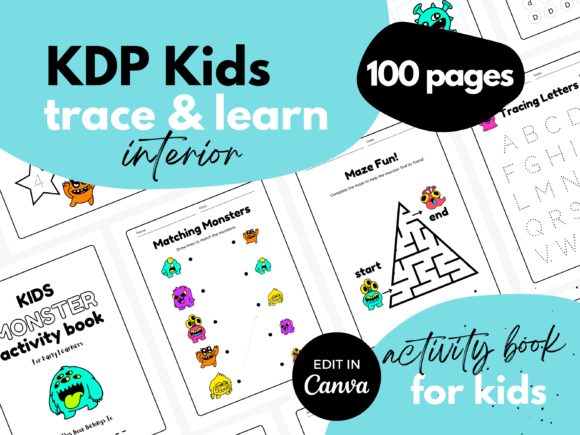
At its core, a Kids Coloring and Tracing Activity Book in this context is a pre-designed digital product intended for KDP publishers. It is not a physical book but a template—often a Canva template—that contains 100 pages of coordinated activities. The content usually blends entertainment with foundational learning, covering areas such as coloring, line tracing, shape matching, color recognition, alphabet practice, numbers, and counting. The distinct proposition here is the combination of a specific, engaging theme (like playful monsters) with a structured, multi-activity framework. This is contrasted with single-focus books or completely blank coloring pages.
Furthermore, these interiors are marketed as "no bleed" for 8.5x11 inch formats, which simplifies the printing specification process for new publishers. The reliance on the free version of Canva as the only required tool is a significant operational feature, positioning it as an accessible option for those without advanced graphic design software or skills.
Key Strengths and Practical Benefits
This model offers several concrete advantages for certain publishers. The primary strength is time efficiency and reduced production risk. A thoughtfully designed 100-page template eliminates the need to individually create, layout, and ensure educational consistency across a wide variety of activities. For a designer fellow KDP publisher, as the description often notes, this implies the interior has been tested for visual appeal and logical flow, which can contribute to positive customer reviews.
Another considerable benefit is flexibility in product strategy. The bundle can be published as a single comprehensive workbook, or its pages can be segmented to create multiple shorter, niche books—for example, a standalone "Monster Alphabet" book or a "Number Tracing with Monsters" book. This allows publishers to test different markets and price points without additional design work. The use of a vibrant, unique theme like colorful monsters can aid in differentiation in a crowded marketplace, potentially increasing visibility on platforms like Amazon.
The dependency on Canva's free version also lowers the barrier to entry. Compared to workflows requiring paid software like Adobe InDesign or specialized illustration tools, this model keeps costs minimal and leverages a platform many users are already familiar with for basic edits and customization.
Trade-offs and Limitations to Consider
While the benefits are clear, this approach naturally involves some trade-offs. The most prominent is the degree of creative control. Using a pre-made template means adopting its established aesthetic, page order, and activity mix. Publishers who wish to implement a highly original art style, a different pedagogical sequence, or incorporate specific cultural or narrative elements may find the template restrictive. It is a product optimized for convenience and quality, but not for unique customization beyond basic color or text changes possible in Canva.
Additionally, the "low-content" or "no bleed" nature defines its scope. These books are focused on activities and are not suited for publishers aiming to create story-driven picture books or high-content educational textbooks. The 8.5x11 no-bleed format is standard for many activity books, but publishers targeting a premium feel with full-cover artwork might seek bleed-enabled interiors in different dimensions.
Finally, the success claim of garnering five-star reviews is predicated on the template's inherent quality and the publisher's effective marketing and customer service. The template is a tool; the final book's market reception still depends on factors like title, description, cover design, and competitive pricing.
Comparison with Alternative Publishing Approaches
When evaluating the Kids Coloring and Tracing Activity Book template, it is useful to consider it within the broader spectrum of KDP children's book creation.
- Fully Custom, Original Design: This alternative involves hiring a designer or creating every page independently. It offers maximum uniqueness and brand alignment but requires significant investment in time, money, or skill. The template model is a practical alternative for those prioritizing speed and cost.
- Single-Activity or Specialty Books: Some publishers focus deeply on one activity type, such as complex mandala coloring for older children or advanced letter tracing workbooks. The multi-activity monster book provides broader, foundational skill practice, making it potentially more suitable for preschoolers or parents seeking a general learning supplement.
- Physical Assembly vs. Digital Template: Some suppliers sell physically printed interiors or PDFs that cannot be edited. The Canva-template model sits in a middle ground, offering a structured design that still allows for minor digital adjustments before publishing, which can be a decisive factor for publishers wanting to add their logo or modify a page.
The choice often hinges on the publisher's resources, design competency, and target audience's expected needs.
Determining the Right Fit for Your Project
A Kids Coloring and Tracing Activity Book with a fun monster theme is likely an excellent fit in several specific scenarios. If you are a new KDP publisher seeking a first project with a low upfront investment and a reduced learning curve, this template provides a clear path. It is also well-suited for publishers targeting the preschool and kindergarten age group with a product that balances fun with basic educational outcomes. Furthermore, if your strategy involves creating a series or multiple books from one asset to scale your catalog efficiently, the divisible 100-page bundle aligns directly with that goal.
Conversely, you might need another option if your vision requires a highly specific theme unrelated to generic monsters (e.g., space exploration, regional animals), or if you aim to serve a niche educational need not covered by the included activities. Publishers with strong graphic design capabilities or those intending to build a uniquely branded line of books might find starting from a blank canvas or a more flexible, component-based design service a better long-term fit.
Making an Informed Decision
The decision ultimately rests on aligning the product's offerings with your personal objectives and constraints. Key factors to weigh include your budget for design, your available time, your target age range and their learning stage, and your desire for brand distinctiveness. A Kids Coloring and Tracing Activity Book template represents a validated, efficient solution that can deliver a quality product to market quickly. By understanding its structured design, its reliance on accessible tools like Canva, and its inherent trade-offs between convenience and customization, you can better assess whether it serves your specific publishing journey or if exploring a more tailored alternative is warranted.
In the diverse ecosystem of KDP interiors, such templates occupy a valuable space for pragmatic creators. They democratize the ability to publish engaging children's activity books, provided the pre-set theme and content align with the publisher's goals and the intended audience's expectations.