The Complete Guide to Crafting Your Personal Knitting Journal
For the passionate knitter, the process is often more than just producing a final garment or accessory. It is a journey of creativity, problem-solving, and personal achievement. Yet, the details of these projects—the yarn choices, the modifications, the lessons learned—can fade over time, lost to memory once the piece is gifted or worn. This is where the concept of a dedicated knitting journal logbook transforms a hobby into a documented craft. A thoughtfully designed Knitting Journal Logbook – KDP Interior provides the structured space to capture this journey, turning ephemeral ideas into a permanent, personal reference library.
Beyond the Notebook: The Anatomy of a Purposeful Knitting Logbook
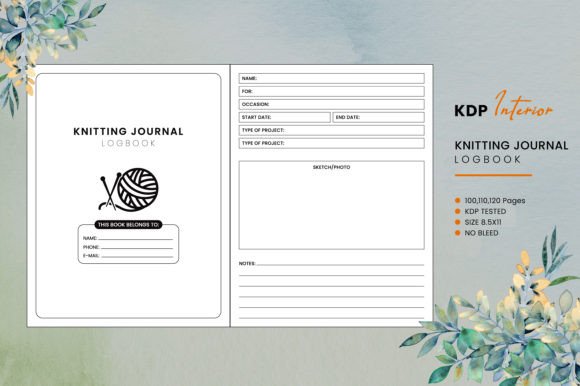
A simple blank notebook can serve as a log, but a specialized interior elevates the experience. The design of a Knitting Journal Notebook Kdp Interiors is built around the knitter’s workflow. It typically includes sections for project planning, progress tracking, and retrospective notes. Essential pages might start with a project overview: pattern name, source, intended recipient, and start date. Following this, dedicated pages for yarn and needle details ensure that even years later, you can recall the exact brand, colorway, weight, and fiber content used.
The core of the logbook is often the progress tracker. This isn’t merely a checklist; it’s a narrative space. Entries can note where you left off, record gauge changes, document tricky sections like intricate cable turns or colorwork joins, and even log the time spent per session. This transforms the tracker into a powerful troubleshooting tool. If a sleeve seems too long, you can review your row counts. If the drape feels off, you can revisit your noted needle size adjustments.
Integrating the Logbook into Your Creative Workflow
The real-world relevance of a knitting journal becomes clear when integrated into a maker’s routine. Consider starting a new project: before casting on, you fill in the planning pages. This act forces clarity—deciding on modifications upfront, calculating yardage needs, and setting a realistic timeline. As you knit, the habit of a quick log entry after each session, perhaps noting "joined front and back at row 45, no issues," builds a disciplined record.
This workflow is particularly advantageous for knitters who work on multiple projects concurrently or those who revisit patterns. Your journal becomes the central hub for all active projects, eliminating confusion. Furthermore, the act of writing can solidify understanding. Describing how you fixed a mistake in written words often leads to deeper comprehension than simply fixing it and moving on.
Characteristics of a High-Quality KDP Interior for Knitters
When discussing a Knitting Journal Logbook – KDP Interior designed for platforms like Kindle Direct Publishing, certain characteristics define a quality product. The interior must be high-resolution and clean, with crisp, readable typography and well-placed lines or boxes for writing. A logical flow from section to section is crucial, guiding the user naturally from planning to completion. For physical print on demand books, considerations like trim size (8.5 x 11 inches) and no bleed design are practical necessities, ensuring the final printed product looks professional and functions perfectly.
The advantage of an editable source file, such as an EPS, allows for customization. A knitting guild might adapt a standard Knitting Journal Tracker interior to include guild-specific challenge pages. An educator could add teaching notes or workshop templates. This flexibility highlights that while the interior provides structure, it can also be a starting point for personalized creativity.
Diverse Use Cases: From Hobbyists to Business Owners
The audience for a knitting journal is broad, and its applications vary wonderfully across this spectrum.
- Hobbyists & Memory Keepers: For many, the journal is a sentimental record. It might include photos of finished projects glued onto pages, notes about knitting for a child’s birthday, or reflections on knitting during a particular season. This logbook becomes a cherished diary of craft and life.
- Designers & Pattern Testers: Professionals use these journals as vital technical documents. They log pattern iterations, yarn substitutions, feedback from test knitters, and detailed construction notes. A single project might span dozens of pages, forming the backbone of future pattern writing or revision.
- Educators & Workshop Leaders: In a teaching context, a knitting journal can be a student’s learning portfolio. Assignments to log specific techniques, compare yarn behaviors, or plan a simple project help translate hands-on skill into conceptual knowledge.
- Business Owners in the Craft Industry: Small business owners who sell hand-knit items or kits can use journals for inventory tracking, customer order specifications, and production timelines. It adds a layer of organization and professionalism to a creative business.
The Advantage of a Ready-to-Use Digital Interior
For creators looking to produce their own Knitting Journal Notebook for sale or community use, the availability of a PDF ready to upload and KDP tested interior is a significant advantage. It removes the technical barriers of design, layout, and formatting for Amazon KDP books. One can focus on marketing, niche targeting, or community building rather than struggling with graphic design software. This accessibility empowers more people to contribute useful tools to the knitting community.
Observations on Long-Term Value and Knowledge Building
Over time, a consistently used journal evolves from a simple log into a knowledge base. You might observe, through your entries, that a certain yarn brand consistently pools in a way you dislike, or that your gauge is always tighter with silk blends. These are personal insights that generic guides cannot provide. The journal also becomes a repository for inspiration. Skimming through past projects can spark ideas for color combinations or remind you of a pattern you loved but never finished.
There is also a psychological benefit to the process. Completing a project and then completing its journal entry provides a double sense of accomplishment. It formalizes the finish. For larger, challenging projects, the progress tracker serves as a motivator, visually representing forward movement and breaking a daunting task into documented, manageable steps.
Key Considerations When Adopting a Knitting Journal System
While the benefits are clear, success with a knitting journal logbook depends on a few considerations. The first is choosing a format that suits your style. Some prefer the tactile nature of a physical print book, while others might opt for a digital printable PDF to use on a tablet, allowing for inserted screenshots and digital photos. The second is developing a habit that is sustainable. Overly complex logbooks can become a burden. The goal is to find or customize a Knitting Journal Logbook – KDP Interior that feels helpful, not cumbersome.
Finally, the content should serve you. If tracking time spent isn’t useful, ignore that section. If you want more space for sketching design ideas, add it. The journal is a tool, and like any good tool, it should adapt to the hand that uses it. The structure provided by a professional interior is a framework, but the most valuable entries will always be the personal observations, the unique solutions, and the creative detours that you record within its pages.
From Logbook to Legacy
In essence, a knitting journal logbook is more than an organizer or planner. It is an active participant in the craft. It encourages mindful knitting, reinforces learning, and preserves a narrative that would otherwise dissolve. Whether using a pre-designed interior for Kindle Direct Publishing or adapting one for personal use, the act of maintaining such a record deepens the connection between the maker, the material, and the made object. It transforms a series of projects into a documented legacy of skill, creativity, and personal growth.