Unlocking Structured Creativity with the Brain Strome Planner Logbook
The modern professional landscape demands not only creativity but also organization. Ideas flow quickly, projects multiply, and goals can feel scattered without a central system to capture and direct them. For many adults—from entrepreneurs launching a venture to educators planning a curriculum—the challenge lies in bridging the gap between raw inspiration and actionable, structured output. This is where a dedicated tool for thought organization becomes invaluable, and the Brain Strome Planner Logbook 1 offers a practical solution designed for this specific purpose.
Essentially, the Brain Strome Planner Logbook is a structured notebook interior focused on idea development and project planning. Unlike a generic journal, it provides a framework to log thoughts, brainstorm systematically, and track progress. The value lies in its intentional design: it guides you to move from chaotic brainstorming to clear, executable steps. For the freelancer juggling multiple clients, the marketer outlining a campaign, or the hobbyist planning a complex personal project, this structured approach can transform a fleeting idea into a tangible plan.
A Tool for Transforming Ideas into Action
Creativity often sparks in unstructured moments, but its real power is harnessed through structure. The Brain Strome Planner Logbook acts as a container for that creative chaos, offering designated spaces to expand, connect, and prioritize thoughts. Consider a common scenario: a small business owner identifies a new market opportunity during a casual conversation. Without a system, that insight might be forgotten or scribbled on a loose note never revisited. With the Brain Strome Planner Logbook, that initial idea can be immediately logged, then expanded into a SWOT analysis, broken down into preliminary tasks, and assigned rough timelines on subsequent pages. This process turns a momentary spark into a viable business development project.
The logbook's design encourages sequential thinking. By providing a consistent format—likely including sections for initial concepts, related ideas, resource lists, and action steps—it reduces the cognitive load of creating a new structure for every single project. This standardization saves significant time and mental energy. You're not designing a planning system each time you start; you're simply filling in a proven framework. For professionals under constant time pressure, this efficiency gain is a meaningful benefit, allowing more focus to be directed to the content of the work rather than its organization.
Who Benefits Most from This Structured Approach?
The applicability of the Brain Strome Planner Logbook 1 is broad, but it resonates particularly with individuals whose work involves multi-stage projects or layered creative processes. Content creators and bloggers, for instance, can use it to map out article series, from initial theme brainstorming to keyword research, outline drafting, and publication scheduling. Educators can plan entire modules, linking learning objectives to activity ideas and required materials. The structured pages help ensure that no critical component of a complex plan is overlooked.
Similarly, entrepreneurs and solo founders often operate as the chief strategist, marketer, and product developer simultaneously. A tool that helps compartmentalize and track these disparate strands of thought can prevent overwhelm and strengthen strategic communication. When you need to present your vision to a partner, investor, or team, having a coherent, written logbook provides a clear reference point, improving the clarity and confidence of your presentation. It turns internal brainstorming into external-ready documentation.
However, it's worth considering personal workflow preferences. Some individuals thrive with completely free-form blank notebooks and may find any predefined structure limiting. The Brain Strome Planner Logbook is best suited for those who appreciate guidance and want to expedite the planning phase without sacrificing depth. It's a fit for the organized creative or the logical dreamer.
Beyond the Digital Draft: The Value of a Physical Logbook
In an era dominated by digital apps, the choice of a physical planner logbook offers distinct cognitive advantages. Writing engages the brain differently than typing, potentially enhancing memory and connection-making. The act of manually filling out sections of the Brain Strome Planner Logbook can foster a deeper, more reflective engagement with your plans. Furthermore, a physical book serves as a single, unified artifact for a project—free from the distractions of notifications or the temptation of multi-tasking that digital environments often invite.
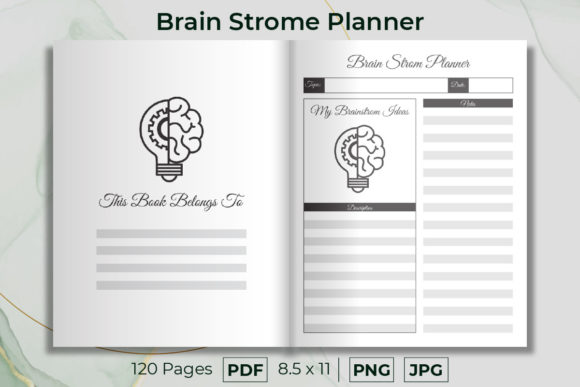
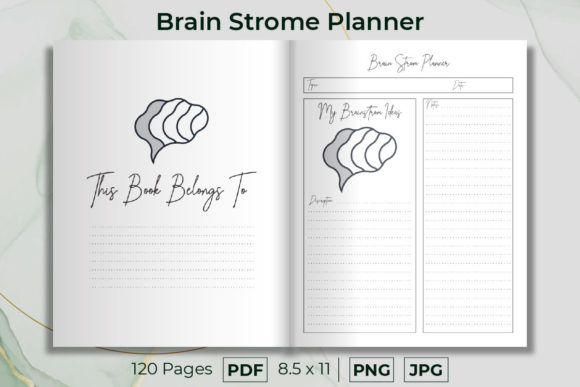
The related product, the Brain Strome Planner Logbook KDP Interior 1, extends this value into the realm of publishing and customization. This interior package is a printable book design ready for upload to platforms like Amazon KDP (Kindle Direct Publishing). It includes a 120-page PDF, high-resolution PNG and JPG files, and is formatted for the standard 8.5x11 inch size. This is particularly valuable for a different audience: publishers, coaches, or small businesses who wish to create their own branded planning tools. Instead of merely using a logbook, you can publish and sell one. The editable source files allow for customization, enabling you to tailor the interior to a specific niche—for example, adding industry-specific terminology or adjusting sections for a particular creative methodology.
Practical Applications and Real-World Outcomes
Imagine a freelance graphic designer using the Brain Strome Planner Logbook for a client rebranding project. Page one captures the client's initial desires and the designer's first impressions. Subsequent pages are used to brainstorm visual themes, list competitor references, and sketch a timeline for logo drafts, palette development, and final delivery. The outcome is a coherent project trajectory that the designer can share with the client for alignment, reducing miscommunication and last-minute changes. The logbook has facilitated stronger communication and increased efficiency.
For a novelist or writer, the logbook could become the central repository for a book's development. Character ideas, plot twists, chapter outlines, and research notes can all be housed in a structured yet flexible manner within its pages. This simplifies the daunting decision of "where to put what," solving the problem of scattered notes across different apps and notebooks. It supports the overarching goal of completing a manuscript by providing a dedicated, physical space for its growth.
A Considered Approach to Personal Productivity
No tool is a universal panacea. The effectiveness of the Brain Strome Planner Logbook hinges on consistent use and a willingness to engage with its structure. Its benefit is not automatic; it requires the user to commit to the process of regular logging and review. For those who already have a deeply ingrained and effective digital system, adopting a physical analog might feel like a step backward. Yet, for many seeking to reduce digital fatigue or to cultivate a more mindful, intentional planning practice, this logbook offers a tangible alternative.
Ultimately, the Brain Strome Planner Logbook 1 and its KDP interior counterpart address a core need in professional and creative life: the need to give shape to thought. They provide a scaffold upon which complex ideas can be built, examined, and advanced. Whether you are using it to streamline your own workflow or leveraging the KDP interior to create a product for others, the focus is on meaningful outcomes—clearer plans, saved time, and realized projects. By offering a structured path from brainstorming to execution, it helps ensure that valuable ideas don't just remain as thoughts but evolve into results.