Navigating Self Care Planner Options: A Look at the Self Care Planner KDP Interior V8
For creators and entrepreneurs in the self-care space, producing a tangible tool like a planner can be a rewarding project. The market offers a myriad of resources to help bring these ideas to life, from fully custom-designed notebooks to pre-made interiors ready for publication. Among these resources, digital templates like the Self Care Planner KDP Interior V8 represent a specific category of product designed to streamline the creation process. Understanding what this offering entails, its distinct characteristics, and how it compares to other approaches is crucial for anyone looking to publish a self-care planner efficiently and effectively.
What Is the Self Care Planner KDP Interior V8?
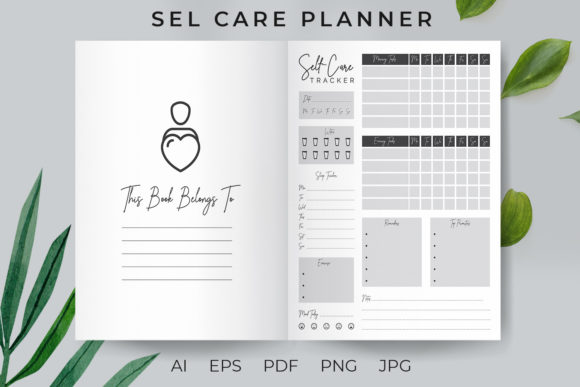
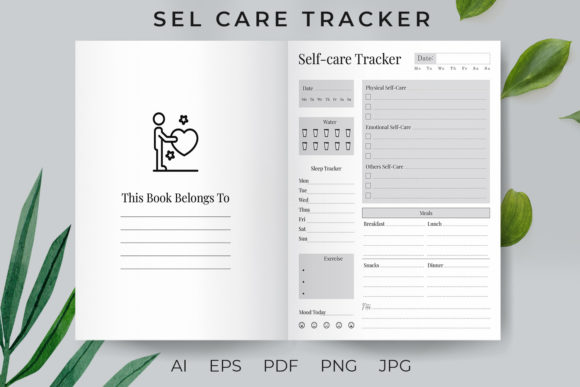
The Self Care Planner KDP Interior V8 is a digital product bundle specifically formatted for use with Amazon's Kindle Direct Publishing (KDP) platform. It is described as a printable KDP interior book, meaning it is a complete set of page designs intended to be the inside content of a physical planner. The core of the package is a 120-page PDF file that is pre-formatted to KDP's specifications for an 8.5x11 inch book, ready for immediate upload. Beyond the final PDF, the bundle typically includes editable source files, such as Adobe Illustrator (AI) and EPS files compatible with Creative Cloud versions, and high-resolution PNG images of individual pages or elements. This combination provides both a finished product for quick use and the raw materials for customization.
What makes this particular offering distinct is its version labeling ("V8"), suggesting iterative improvements, and its comprehensive inclusion of both ready-to-use and editable assets. It is positioned not just as a static template but as a flexible toolkit. The focus on self-care—a broad category encompassing mental, physical, and emotional well-being—means the interior pages are likely structured around prompts for goal setting, habit tracking, mood logging, reflection, and relaxation exercises, formatted in a clean, usable layout.
Comparing Development Approaches for Self-Care Planners
When considering how to create a self-care planner, several paths exist, each with different tradeoffs in time, cost, creative control, and technical skill required. The Self Care Planner KDP Interior V8 sits within a spectrum of options.
Fully Custom Design from Scratch
This approach involves hiring a graphic designer or using design software oneself to create every page uniquely. It offers maximum creative control and originality, allowing the planner to perfectly match a specific niche or brand aesthetic. However, it is the most resource-intensive path, requiring significant time, advanced design skills, or a substantial financial investment for professional services. For someone with a very unique vision or a established brand needing a bespoke product, this might be the necessary route. The Self Care Planner KDP Interior V8, by contrast, drastically reduces this upfront effort.
Using Pre-Made Templates or Interiors
This is the category where the V8 product resides. Templates range from simple, minimally editable PDFs to complex bundles with source files like the one discussed here. A key comparison point among templates is the level of editability provided. Some products offer only a final PDF, which is perfect for someone who wants to publish immediately with no changes but offers zero flexibility. The inclusion of AI and EPS files in the V8 bundle is a significant strength for those who want to alter colors, fonts, layout structures, or add their own branding elements. This positions it as a hybrid option: faster than custom design but more adaptable than a locked PDF.
Assembly from Component Libraries or Marketplaces
Another alternative is sourcing individual page designs—like separate habit tracker sheets, monthly calendars, or journal pages—from stock asset marketplaces and assembling them into a cohesive interior. This can be cost-effective and allows for picking the best individual components, but it requires strong editorial and design skill to ensure a consistent look and logical flow throughout the final book. The Self Care Planner KDP Interior V8 provides a pre-assembled, coherent 120-page sequence, eliminating the assembly and consistency challenge, which is a major benefit for creators who prioritize a polished, professional outcome without that manual compilation work.
Evaluating the Strengths and Tradeoffs of the V8 Package
The specific composition of the Self Care Planner KDP Interior V8 bundle invites a practical evaluation of its advantages and limitations.
A primary strength is its practical readiness. The 120-page PDF formatted for 8.5x11 inches meets KDP's technical requirements, reducing the risk of formatting errors during upload. For a creator whose goal is simply to get a functional, well-designed self-care planner to market quickly, this is a considerable advantage. The included high-resolution PNGs also offer utility; they could be used for social media promotion, as digital printables sold separately, or extracted for use in other projects.
The editability factor, through the AI and EPS source files, is another significant benefit. It opens the door for moderate customization. A creator could change the color scheme to align with their brand, adjust fonts for better readability, or even swap out specific page layouts if they possess basic skills in vector design software. This is a tradeoff, however: it requires access to and familiarity with Adobe Illustrator or similar software. For someone without these skills or who doesn't wish to learn them, the editable files may be an unused part of the bundle, making a simpler PDF-only template a more straightforward purchase.
A potential limitation lies in its fixed structure and page count. While editable, the planner comes as a defined 120-page set with a presumed sequence and content focus on general self-care. For a project needing a very specific page count (like 90 or 150 pages) or a highly specialized focus—such as a planner exclusively for mindfulness meditation, fitness, or career self-care—this pre-built interior might not be the perfect fit. It may require substantial modification or might serve better as a starting point for a different project. In such cases, the component assembly approach or a custom design might be more suitable.
Decision Factors: When Is This the Right Choice?
Choosing the Self Care Planner KDP Interior V8 depends heavily on the creator's specific situation, resources, and goals.
It is likely an excellent fit for an individual or small business that wants to launch a self-care planner with minimal time investment and moderate customization ability. Imagine a life coach who wants to offer a physical planner to clients alongside their services. They have a brand color and logo but lack the weeks needed for full design work. Using the V8 interior, they can quickly upload the PDF for an immediate product, and later, with some design help, use the source files to incorporate their branding for a second, more branded edition. The bundle supports both immediate and phased strategies.
It also suits creators who value professional design but have limited budgets. Compared to hiring a designer for a full custom project, purchasing a template like this is far more economical. The quality of the pre-designed layouts—assuming they are well-crafted—provides a professional result that might be difficult to achieve independently without extensive design experience.
Conversely, this option may not be the best fit for someone with very advanced or unique design requirements. If the vision involves intricate illustrations, unconventional page sizes, or interactive elements beyond standard tracker layouts, starting from a template might be more restrictive than helpful. Similarly, for a creator who intends to produce a whole series of planners with wildly different interior themes, investing in a custom design process that establishes a unique, reusable template for their brand could have longer-term value than purchasing individual pre-made interiors for each theme.
The inclusion of multiple file types (PDF, AI, EPS, PNG) makes the V8 bundle a versatile resource. However, the decision also hinges on the creator's technical comfort. Those comfortable with design software will leverage the full value. Those who are not might find a simpler, PDF-only product from another provider less overwhelming, even if it offers less future flexibility.
Moving Forward with an Informed Selection
Selecting a tool like the Self Care Planner KDP Interior V8 is ultimately about aligning a product's capabilities with a project's needs. Its core offering—a balanced mix of ready-to-publish convenience and foundational editability—makes it a compelling option for a wide range of creators entering the self-care planner market. By comparing it to the broader landscape of development approaches, from full custom work to basic template use, one can appreciate its role as a middle-path solution that mitigates both the high cost of custom design and the rigidity of non-editable templates.
The key is to assess one's own priorities: Is speed to market paramount? Is there a need for basic brand customization? What is the level of available design skill or budget for further modification? Answering these questions will clarify whether this specific interior bundle is the right resource or whether exploring alternatives like component assembly or a different template with a more specialized focus would yield a better result. In the diverse ecosystem of self-care products, having such clear, practical comparisons empowers creators to make decisions that best support their unique projects and goals.